
Key Takeaways
- A knocked-out permanent tooth has the best chance of being saved when it goes back in within the first 20 to 30 minutes, so aim to reach a dentist within the hour. How you handle it in those first moments matters enormously.
- Never touch the root. Store the tooth in milk or your own saliva, not tap water.
- Baby teeth are handled differently; do not attempt to reinsert a knocked-out primary tooth.
- If the golden hour has passed, restorative options like dental implants can still fully restore your smile. It’s not too late to get help.
Last Updated: October 21, 2026
Table of Contents
- What Is the “Golden Hour” for a Knocked-Out Tooth?
- Act Now: What To Do in the First 60 Minutes
- What Is the Best Liquid to Store a Knocked-Out Tooth In?
- Should You Try to Put the Tooth Back in the Socket?
- Baby Tooth or Adult Tooth: Does It Change What You Do?
- What If You Missed the Golden Hour? Your Options Are Not Gone.
- How Do You Prevent This From Happening Again?
- Don’t Wait: We’re Ready Right Now
- What To Do Next
- Frequently Asked Questions
What Is the “Golden Hour” for a Knocked-Out Tooth?
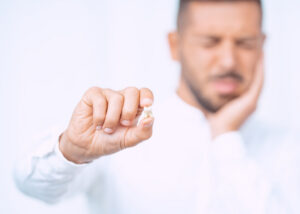
When a permanent tooth is knocked out (what dentists call a dental avulsion), the root surface cells start to die once the tooth dries out, and the chance of successful reattachment drops with every minute. Outcomes are best when the tooth is replanted in the first 20 to 30 minutes, which makes getting to a dentist within the hour the goal. That window is the golden hour.
This is a genuine dental emergency. The decisions you make in the next few minutes can be the difference between saving a natural tooth and needing a replacement. Our Ventura emergency dental team is ready to see you immediately, but first, here’s exactly what to do before you arrive. If you are not sure whether a mouth injury needs urgent care, our guide to the signs of a dental emergency in Ventura sorts symptoms by urgency.
Act Now: What To Do in the First 60 Minutes
Time is the variable you can control. Work through these steps as quickly and calmly as possible.
Step 1: Find the Tooth and Handle It Correctly
Pick up the tooth by the crown, the white part you normally see in the mouth. Do not touch the root. The root surface is covered in periodontal ligament cells that are critical to successful reattachment, and handling the root can damage them.
Step 2: Rinse It the Right Way
If the tooth is visibly dirty, rinse it briefly under cold running water, with the sink plugged first. Do not scrub it, use soap, or wrap it in a dry tissue. A quick rinse is fine, but never store the tooth in water; we explain why below.
Step 3: Reinsert or Store It Immediately
For adults and older children with permanent teeth: if you can do so without forcing it, gently reinsert the tooth into its socket and hold it in place by biting down softly on a clean cloth. If reinsertion isn’t possible, place the tooth in a small cup of milk or tuck it between your cheek and gum to keep it moist in your saliva.
Step 4: Get to Avra Dental Right Now
Call us immediately and head to our office at 1708 S Victoria Ave B, Ventura. Every minute counts. Let us know you’re coming so we can prepare for prompt emergency care the moment you walk through the door. For other urgent problems, our complete emergency dental guide for Ventura covers triage and costs.
What Is the Best Liquid to Store a Knocked-Out Tooth In?
This is one of the most common questions, and the answer surprises many people.
Milk is the best widely available option. Here’s why it works on a biological level: the root surface cells (periodontal ligament cells) require a specific osmotic pressure and pH to survive outside the mouth. Milk closely matches those conditions, which is why it can help preserve cell viability for up to 30 to 60 minutes. Plain saline is a short-term backup if milk isn’t available. Contact lens solution is not a substitute; studies found it worked worse than saline or milk.
Tap water, on the other hand, should be avoided for storage. Water is hypotonic, meaning its osmotic pressure is far lower than the cells require. Storing a knocked-out tooth in tap water causes those root cells to swell and break down, reducing the chance of successful reattachment. It is a common mistake, and an avoidable one.
If nothing else is available, the inside of your own cheek is an acceptable short-term option. Your saliva keeps the tooth moist for a short time, ideally under 30 minutes.
| Storage Medium | Viability Window | Recommended? |
| Milk | Up to 30 to 60 min | Yes, first choice |
| Saline | Short term only | Yes, backup |
| Saliva (in cheek) | Up to 30 min | Yes, if nothing else available |
| Tap Water | Not suitable (damages root cells) | No |
| Dry (tissue/pocket) | Minutes | No |
Sources: International Association of Dental Traumatology; Khinda et al., Clinical and Practical Implications of Storage Media used for Tooth Avulsion, International Journal of Clinical Pediatric Dentistry, 2017
Should You Try to Put the Tooth Back in the Socket?
For permanent teeth in adults and older children: yes, gentle reinsertion is typically the best option if you can do it without forcing the tooth. Hold it by the crown, orient it correctly, and ease it into the socket. Bite down lightly on a clean cloth to hold it in place and get to our office immediately.
If you’re unsure of the orientation, or if there’s significant swelling or bleeding that makes reinsertion difficult, do not force it. Place the tooth in milk and let our team handle the reimplantation with the precision and care it requires.
Baby Tooth or Adult Tooth: Does It Change What You Do?
Yes, and this distinction is critical for parents.
If your child’s baby (primary) tooth is knocked out, do not attempt to reinsert it. Reinserting a primary tooth can damage the developing permanent tooth beneath the gum line. The right move is to keep your child calm, control any bleeding with gentle pressure using a clean cloth, and call us so we can assess the situation and monitor the site as the permanent tooth develops.
If your child’s permanent tooth is knocked out (typically in children ages 7 and older), the golden hour rules apply the same as they do for adults. Act quickly, handle by the crown, store in milk, and call us immediately.
We treat families across Ventura, and we understand how frightening this is for a parent. You’re not alone; our team will walk you through every step the moment you call.
What If You Missed the Golden Hour? Your Options Are Not Gone.
If it’s been more than an hour, or if the tooth cannot be saved, we want you to hear this clearly: your smile is not gone.
Modern restorative dentistry has advanced to the point where a missing tooth, even a front tooth, can be replaced with a result that looks, feels, and functions like your natural tooth. At Avra Dental, we plan implant placement with a 3D scan and color-match the final crown to your surrounding natural teeth.
Dental implants are typically the gold standard for replacing a single missing tooth. A titanium post is placed into the jawbone, a custom crown is attached, and the result is a permanent, stable tooth that doesn’t shift, doesn’t require adhesives, and preserves the bone structure of your jaw. Most patients forget which tooth is the implant. If you have low bone density, our guide to dental implants with osteopenia in Ventura explains what that label does and does not change.
If implants aren’t the right fit for your situation, we’ll walk you through every option, including bridges and other restorative approaches, with zero pressure and complete transparency. There’s no judgment here, only solutions. Let’s restore your smile together.
How Do You Prevent This From Happening Again?
Ventura’s surfing breaks, skate parks, and sports fields are part of what makes this community exceptional, and they also put teeth at risk. Dental injuries happen in contact sports and in non-contact activities such as skating, and the American Dental Association recommends a mouthguard for sports and recreational activities. Our surfer’s and cyclist’s guide to outdoor dental injuries covers the most common local scenarios.
A custom-fitted mouthguard made by a dentist is considered the most protective type available. Stock guards often fit poorly, can be bulky, and can make breathing and talking difficult. A custom guard is made for a precise fit, stays in place, and causes minimal breathing and speech issues while you compete.
If you or your child plays any contact or high-impact sport (or surfs, skates, or rides), talk to us about preventing sports dental injuries at your next visit. It’s one of the simplest investments you can make in long-term oral health.
Don’t Wait: We’re Ready Right Now
If a tooth has just been knocked out, stop reading and call us.
Avra Dental, 1708 S Victoria Ave B, Ventura, CA 93003
Call for Immediate Emergency Care
Dr. Jabaiti and our team are prepared to see dental trauma cases urgently. Bring the tooth stored in milk, and we will do everything in our power to save it or, if the window has passed, to restore your smile with the advanced care and personalized attention you deserve.
Whether it’s been ten minutes or ten days, we’re here, we’re ready, and we can help.
What To Do Next
- Emergency right now? Phone our office right away and come straight to our Victoria Ave location; time matters.
- Missed the window? Book a consultation to explore dental implant and restorative options, with no judgment, just solutions.
- Want to prevent this? Ask us about mouthguard options for athletes at your next visit.
Frequently Asked Questions
How long can a knocked-out tooth survive outside the mouth?
A knocked-out permanent tooth may remain viable for reimplantation for roughly 30 to 60 minutes when stored properly in milk or saline. The sooner you reach a dentist, the better the outcome typically is.
Can a dentist put a knocked-out tooth back in after 2 hours?
Reimplantation after two hours is possible in some cases, but the likelihood of long-term success decreases significantly as time passes and root surface cells deteriorate. A dentist will assess viability and discuss all restorative options with you.
What happens if a knocked-out tooth dies?
If the tooth cannot be successfully reimplanted or if it fails after reimplantation, the gap can be restored with a dental implant or bridge. A missing tooth should be addressed, because leaving the space untreated can lead to bone loss in the jaw over time.
How much does it cost to fix a knocked-out tooth?
Costs vary depending on whether the tooth can be reimplanted or requires replacement. Emergency reimplantation, dental implants, and bridges each carry different price points. We recommend calling our office directly for a consultation. We accept most major insurance plans and will review your options transparently. To understand how a PPO plan may apply, read our explainer on how PPO dental insurance actually works.
